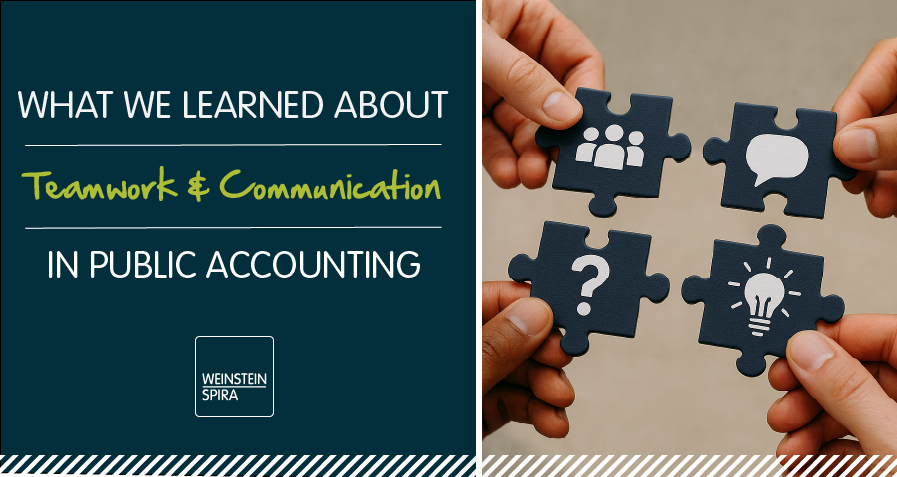
As interns at Weinstein Spira, we entered public accounting with certain expectations, mainly centered on technical skills and processes. Looking back on our internship, we realized that teamwork, communication and collaboration played a far larger role than we initially anticipated and that these lessons shaped our growth throughout the experience. In this blog, we share what we learned about asking questions, working with a team, managing deadlines and developing the professional skills essential for success in public accounting.
The Role of Teamwork and Communication in Public Accounting
When we started our internship, we assumed that success would depend primarily on technical skills such as understanding professional standards, preparing workpapers accurately and following the appropriate procedures. While those abilities are essential, we quickly realized they represent only part of what it takes to perform well. Public accounting is built on collaboration, and strong communication skills are just as critical as technical knowledge.
As we progressed through our internship, it became clear that teamwork drives every engagement. Each project involves multiple people working under tight deadlines, shifting priorities and complex client needs. Clear and consistent communication keeps the work organized and the team aligned. Whether we are clarifying expectations, coordinating with seniors and managers, or updating others on our progress, the way we communicate directly influences both the quality of our work and the efficiency of the engagement. One of the earliest lessons we learned was the importance of asking questions and ensuring expectations are fully understood from the start.
The Value of Asking Questions and Getting Clarity Early
At first, we often hesitated to ask questions. We worried about interrupting someone who seemed busy or asking something that might appear too basic. However, we quickly discovered that staying silent can create bigger issues, such as missing key information, producing incomplete work or having to redo tasks that could have been completed correctly the first time.
Getting clarity upfront makes a noticeable difference. Even small details, such as how a schedule should be formatted, what documentation is required or how a reviewer prefers information to be presented, can significantly affect the professionalism of the final product. Confirming expectations early helps prevent confusion and ensures our work meets the standards of both the team and the client.
What surprised us most was how much asking questions builds trust. It shows that we are engaged, detail-oriented and committed to producing accurate work. At Weinstein Spira, asking questions is strongly encouraged and is part of the firm’s culture. It is one of the fastest ways to grow professionally and gain a deeper understanding of the work. No one expects new staff to know everything, but they do appreciate proactive communication and the willingness to check in before moving too far in the wrong direction. In the end, it is almost always better to ask one extra question than to redo an entire task.
Strong Attention to Detail Improves the Quality of Your Work
One of the biggest adjustments during an internship is learning just how much attention to detail each workpaper requires. When we are working on a complicated return or navigating an audit, every number tells a story. As we became more comfortable with our workpapers and how they fit into the bigger picture, we gained a deeper understanding of the work overall. Organization plays a huge role in this process. Keeping files updated, knowing what each workpaper is used for and understanding the flow of information are skills you build over time.
It’s normal to feel overwhelmed by new software, new procedures and new information. One of the simplest tools we relied on was a notebook. Writing down tasks, instructions, names and feedback shows initiative and helped us keep track of important details. Documentation becomes a personal roadmap, recording what has been completed, what still needs attention and what you’ve learned along the way.
When your numbers do not tie out, finding the reason is part of the job. Reviewers should be able to follow the work easily, and that only happens when your workpapers are clean, accurate and well organized. Sometimes attention to detail is as simple as checking the year, fixing spelling errors, making sure links work or ensuring formatting is consistent. These small habits add up and make a big difference in the quality of work.
Documentation and attention to detail are two of the strongest skills developed during an internship. They help keep work organized, support reviewers and ultimately help interns stand out. Understanding the bigger picture while investigating small details sets the foundation for long-term success.
Collaboration with the Team
Communication is essential to keeping seniors and managers informed about the status of a tax return, questions about an audit procedure or challenges with a task. One manager shared valuable advice: “You’re not going to know everything. No one does. Everyone is constantly learning and asking questions.” The rules change often in the accounting world and learning never stops. That perspective helped us understand that asking questions is never a weakness. It’s part of doing the job well.
Throughout the internship, we saw firsthand that everyone is working toward the same goal of producing accurate, high-quality tax returns and audits for clients. Feedback plays a major role in achieving that goal. Whether through comments on workpapers, suggestions for improving communication or tips for managing time more effectively, every piece of feedback helped us grow and improve.
Managing Deadlines
Public accounting deadlines are no joke. When busy season begins, the pace shifts immediately. Teams are fully engaged, focused and working together to meet tight deadlines. With multiple clients and overlapping due dates, learning to prioritize tasks became essential.
One thing that stood out to us at Weinstein Spira was how much relationships matter. People genuinely care about one another, especially during busy season. Even small things, like weekly catered lunches, created opportunities to connect, decompress and support each other, whether the conversations were focused on work or life outside the office.
Overall
Soft skills such as communication, teamwork, organization and attention to detail are essential in public accounting. Technical knowledge matters, but the day-to-day work depends just as much on the ability to collaborate, ask questions and manage expectations under pressure. Working closely with seniors, receiving feedback and managing deadlines taught us how to communicate clearly, take ownership of our work and adapt to fast-paced situations. Over time, we became more comfortable navigating a professional environment.
These skills will continue to be valuable throughout our careers. The ability to communicate effectively, work collaboratively and manage time efficiently will always be important. This internship at Weinstein Spira provided a strong foundation for long-term success in the accounting profession.